Changes which were implemented
- “Minutes” to Minutes because it is a big text.
- Added the date it was published to show the relevance of the text with history.
- Added the title, because the essay is meaningless without it.
- Changed to citation in the format of citing an image.
- Added a paragraph explaining why it is important to me.
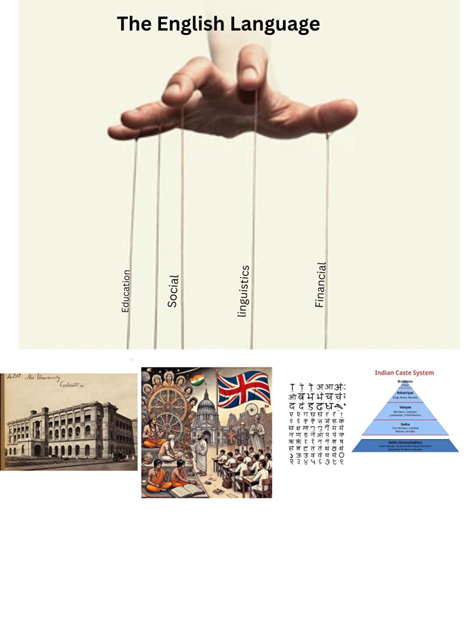
- Added my visual argument to show the rhetoric.
Cover Letter
1) your process of writing and revising so far, including any reflections on the above strategies,
My main goal in this revision was to polish grammatical syntax, adjust and modify language for my audience and made a counter claim to strengthen my argument. I did not bother too much on the wording because it is intentional. I spent time on polishing the essay overall; making sure I do not rely too much on repetition. I tried to smoothen the transition between the sources as much as I could. I felt this piece of writing was getting very biased and even Anglophobic. Considering the suggestions from my peer I decided to put a counter claim in order to strengthen my position on my thesis.
2) who your audience is and how you’ve catered your language choices to their needs,
Ans: Still my audience is an ignorant South Asian who has no clue of his past. I intentionally used emotional language to make a case of my point of view. This essay meant to be a South Asian (me) educating another South Asian (my people).
3) how your thesis (the “big idea” of your essay) has evolved through your writing and researching process (ask yourself: what do I know now that I didn’t know when I started?)
Ans: At the beginning, I thought that my essay would be like any other academic research paper. I never imagined that it could have so much emotion and bias.
Works Cited
Chakravorty, Sanjoy. “Viewpoint: How the British reshaped India’s caste system.” BBC News 19 (2019).
Frith, Francis. The Calcutta University. 1850-1870s. Old Indian Photos, www.oldindianphotos.in/2010_06_20_archive.html. Accessed 28 Nov. 2025.
Macaulay, Thomas Babington. “Macaulay’s Minute on Education, February 2, 1835.” Official Website, IIT Kanpur (1835).
Mathai, Samuel. India Quarterly, vol. 32, no. 3, 1976, pp. 365–67. JSTOR, http://www.jstor.org/stable/45070455. Accessed 16 Nov. 2025.
Nikam, Madhukar Jamrao. “Colonialism, the English Language, and the Decline of Indian Knowledge Systems.” International Journal of Humanities Social Science and Management, vol. 5, no. 1, Jan.-Feb. 2025, pp. 608-614.
Rajan, M. S. “The Impact of British Rule in India.” Journal of Contemporary History, vol. 4, no. 1, 1969, pp. 89–102. JSTOR, http://www.jstor.org/stable/259793 . Accessed 11 Nov. 2025.
Power of The English Language
In conventional terms “colonization” is an evolved version of the original word “Mercantilism.” This word at its core meant to benefit businesses and industries through global trading. It was the root ideology, which was far distant from reality. With all regrets, mercantilism became the diving force for colonization. The ambition is fairly easy to understand; if you know that a territory has a tremendous amount of resources and you can just invade it, then why would you trade with it. The colonization of India is no different than any other colonization Britain had committed itself to, yet it was the biggest and most popular civilization Britain got its hands into. Britain set up tradepost and executed its plan to take over all of India through the strength of its military. India was Britain’s crown jewel, and sustaining it was Britain’s greatest ambition towards its future empire. So, Britain used the only tactic it had mastered: divide and rule. This time, it used the English language as its colonial force. Administrative languages of India such as Sanskrit and Arabic were dismissed as outdated. In addition, the colonizers presented English as a language of social and financial mobility to the natives. Overall it led to a massive social and linguistic divide between the populations; one who is upperclass and speaks in English, and another who is a lower class and speaks in native tongue.
In order to understand the colonial forces of the English language, it is crucial to understand how English has earned its legitimacy as an administrative language among South Asians. A journal article titled, Minutes written by an English politician named Hon’ble T. B. Macaulay and published by Home Secretariat Press in 1835 addresses the topic of legitimacy and necessity of the English Language in India. He argues that English is a superior language to the administrative languages and foreign tongues of India. Furthermore , it is beneficial for the natives to learn English for social mobility and financial gains. He supports his claim as he says that, “A single shelf of a good European library was worth the whole native literature of India and Arabia. The intrinsic superiority of the Western literature is indeed fully admitted by those members of the committee who support the oriental plan of education”(3). This rhetoric presents English as the desired Language that Everyone wants to learn. It creates a fear of missing out on a complex that would make the natives feel vulnerable.
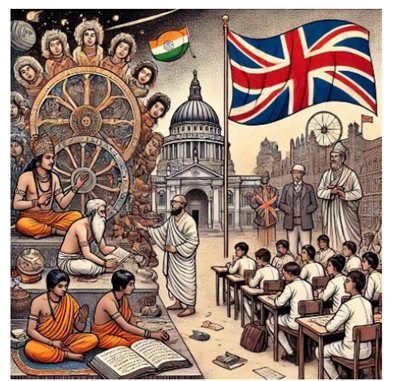
This following cartoon is the perfect depiction of the installation of the English language in the Indian traditional education system. In fact, it is merely an insertion of the English Language. In reality it is a reshaping of an entire society. The clothing of the students makes it evident of the cultural transformation. It won’t only lead to social divide, it would create a generation of self-hating Indians who would consider their education worthless and their culture backwards.
After establishing English as an institutional and educational language, the colonizers arose with their main plan: Divide and rule. It led to extreme social divides. Especially in terms of linguistics when an entire group(upperclass) is proficient in a foreign language and hence they enjoy tremendous knowledge and social mobility. Rajan, who is a professor in colonial history wrote a peer-reviewed journal titled, “The Impact of British Rule in India,” published by Saga Publications in 1969, claims that the forceful integration of the English language with the Indian education system led to an unhappy physiological outcome. He clarifies that, “It created an urban elite in all walks of life which, by its knowledge and use of English,was cut off socially and intellectually from the millions of rural Indians” (95). It explains the linguistic superiority complex and class difference that resulted from the colonial establishment of the English language.
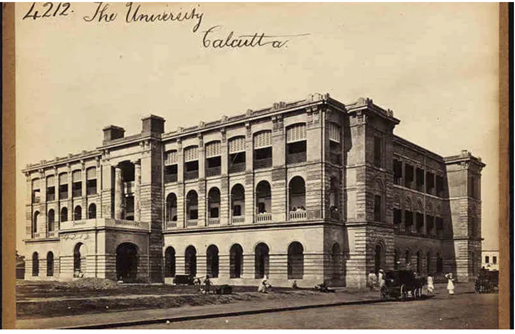
This is University of Calcutta established in Bengal in 1857 by the English bureaucracy. It is notable because it was the first western style university that will provide western style education and literature in South Asia. It is considered to be the biggest contribution towards education in South Asia by the English bureaucracy. In fact, it became the driving force of social and cultural divide. This university attempted to create a class of persons, Indian in blood and color but English in taste. Britain wanted to create an elite class who are Indians by birth yet operate for the English Bureaucracy.
A similar topic to class division is the caste division. The caste system in India is a controversial issue up to this day; the English colonizers and the English language played a key role in it. Generally, India didn’t have proper documentation of their life, society and civilization. So, the colonizer got the opportunity to become the early historians of the civilization. Hence the English bureaucracy could set up the global perception of India or reshape it completely. Sanjoy Chakravorty, who is a writer for the BBC wrote an opinion piece published in 2019 called “How the British reshaped India’s caste system” claimed that the English bureaucracy simplified the caste system of the Hindu culture and depicted Indian society as backward moving, outdated and discriminatory. He supports his claim as he explains how the English bureaucracy undermined faith, regional diversity and social identity for their own convenience. All these factors were shrunk to such an extent that the Indian society was depicted as a society which is completely unparalleled to the world views at that time. In addition, “new categories and hierarchies were created, incompatible or mismatched parts were stuffed together, new boundaries were created, and flexible boundaries hardened” (5).
Despite all the negative reputation of the English treatment of India, there exists a group of colonizer sympathisers who think that the exposure of western values led Indian leaders to understand ideas like liberalism, freedom and justice; which later becomes a cry for decolonization. Aparna Basu who is a historian specialised in modern history of India and social educational history published a book in 1920 named “The Growth of Education and Political Development in India” claimed that, “The British forcefully established English as the main medium of educational language. However, The British bring western values to India like freedom, common law and liberalism. Indian leaders educated under western education were the main reason the decolonization movement began in the first place.” This piece was written during the English colonization, and hence its credibility is highly questionable because it was a piece of writing that was published under a control system and it may sound more appeasing to the system which was ruling at that time. Mathai Samuel who is a critic and book reviewer responded to Basu’s claim as he said, “Basu’s focus on university education and the English-educated elite presents a narrow, top-down view of India’s political development. It overlooks the political consciousness growing among the masses, who were not part of this Western-educated system” It helps see Basu’s idea from a different perspective. Basu’s claim is not incorrect; Indian leaders were the one who led the decolonization movement; provided that they were the ruling and elitist class the colonizer wanted to create. The colonizer’s goal was not to educate the leader; rather they wanted to create an elitist class who were blood in Indian and English in taste. Decolonization of India was no more than an unintended consequence of English/western education that was established by the English bureaucracy.
The English colonization left a deep scar on India. It may not be as noticeable due to the continuous sanitising and reshaping of history. Truly, the suffering of colonization is vibrant in South Asia up to this day. Britain ruled India just like it would rule and exploit any other civilization. It is important to note how they used the English language as a colonial force. It can be used to delegitimize other languages or replace them completely; making natives fear of missing out on their future and finances; exacerbating social and class divide; or creating an entire elite class who would be loyal to the English bureaucracy.
In the contemporary world, the influence of the English language is vibrant in South Asia. As a South Asian it is important to me because I experience it every day. My parents and relatives, with whom I surround myself with, are very ignorant of history. They are very dismissive about the conversation and discussion about how they are being exploited and abused. As a member of my community, I remain to be the only exception who wants to discuss truths which are uncomfortable to many South Asians. I hope that my rhetoric will provide them with a different approach to learn about reality.

This entry is licensed under a Creative Commons Attribution-NonCommercial-ShareAlike 4.0 International license.

